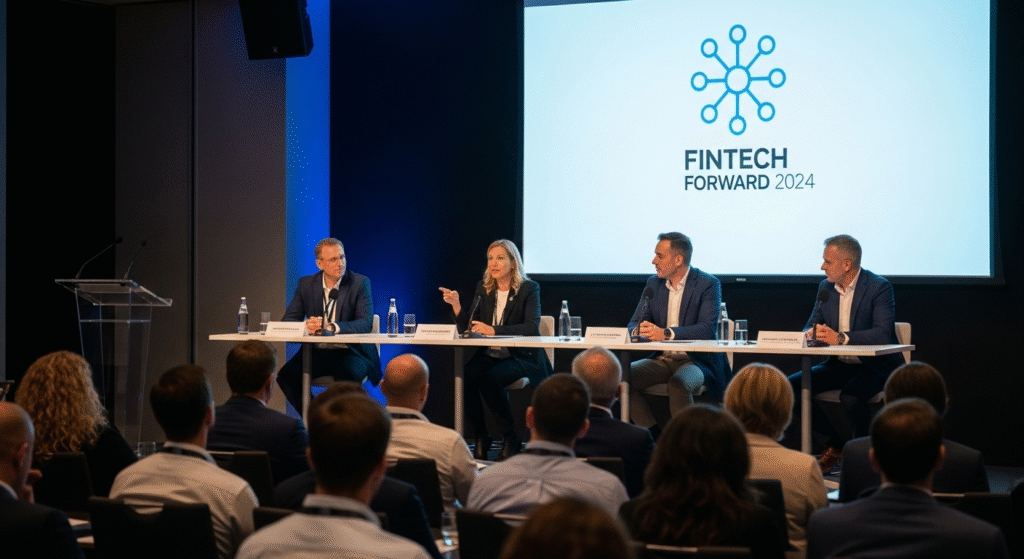
You know how it feels if you’ve ever gone to a big financial conference. It’s not simply a meeting of people in the same field; it’s a busy centre of pure, unadulterated possibility. People are sketching out the future of money on napkins and shaking hands in packed rooms as they drink coffee. But in the middle of all this biological activity, there is one strong force that turns noise into clarity and ideas into action: the conference speaker. These people are no longer merely talking heads that fill up a calendar. They are the modern-day builders of financial advancement, appearing on stage not only to give a speech, but to challenge, connect, and empower. They are the important connection between the complicated technology possibilities and the real, human-centered solutions that are changing the way we handle our money.
- Making Complicated Technology into Solutions that Work for People
There are a lot of acronyms and jargon in the field of fintech. Blockchain, DeFi, and AI-driven regtech may make people who aren’t developers or quants feel like they don’t belong. This is where the speaker’s first and most important job comes in: to be a master translator. The finest financial speakers have a special talent. They can take a really complicated idea, like a decentralised ledger, and make it clear how it will affect people by telling a simple tale. They’ll tell about a small company owner in a rural location who finally gets money, or a migratory worker who sends money home without losing a lot of it to fees. They do more than simply teach when they put technology in the context of how it helps people.
- Creating Strong and Surprising Partnerships
The most innovative fintech solutions typically come from collaborations with financial innovation conference speakers that work well together, like a conventional bank’s stability and a startup’s innovation, or a data scientist’s insight and a behavioural economist’s comprehension. The people who speak at conferences are the best at making these partnerships happen. When a visionary from a heritage institution talks about their problems on stage, it shows that they are open to new ideas. When a startup entrepreneur shows off a flexible solution, it gets the attention of a bigger company that wants to try new things. The stage is a safe place for these signals to be delivered and received. The true magic occurs when people say, “I heard your talk, and it made me think…” These conversations after the speech are when ideas that aren’t very clear get the partners and resources they need to become genuine products.
- Giving a Live Look into the Future of Money
Reports and white papers are helpful, but nothing beats hearing about something personally. Speakers at conferences frequently act as scouts, coming back from the front lines of finance to tell others what they saw. They are the early adopters, beta testers, and research leaders who are making things that the rest of the industry won’t see for another two years. Their talks provide a unique, carefully chosen view of the lab. They may show us a prototype of a new payment rail, provide us statistics on how people act in the metaverse that we’ve never seen before, or talk about the rules they have to follow right now. This live intelligence is quite useful. It lets the whole ecosystem see beyond the horizon, see what’s coming, and make smart choices now that will shape their importance tomorrow.
- Making Knowledge Available to Everyone and Making the Playing Field More Even
In the past, the world’s biggest companies were the only ones who could come up with new ways to make money. The stage is now a really important instrument for making things more democratic. A world-class specialist may give a room full of a thousand people the same advice that they would provide to a private client who paid millions of dollars for consultation. A programmer on Wall Street and a developer in an emerging market may both master the same architectural concepts. This unfettered exchange of information makes the playing field even. It enables new enterprises and creators who aren’t from the conventional areas the fundamental skills and strategies they need to be successful. Speakers make the world of finance more open, varied, and competitive by giving away their hard-earned knowledge for free.
- Making the Digital Transformation of Finance More Human
People are at the heart of finance. It’s about their hopes of purchasing a house, paying for school, or saving for retirement. It’s quite easy to forget about this human side when you’re in a hurry to digitise and automate. The most powerful speakers never let it happen. They are the ones that tell stories that bring the human side of technology back into prominence. They tell stories of the single mother who used a micro-investing app to make her first safety net, or the farmer who utilised a blockchain-based supply chain to obtain a fair price for his crops. These tales aren’t simply emotional extras; they constitute the industry’s moral compass. They remind everyone in the room, including architects, investors, and executives, that their lines of code and financial models have a big and immediate impact on people’s dignity and chances.
Conclusion
There is no straight pipeline from the lab to the market for financial innovation. It is a very human process that works best when people talk to each other and exchange ideas. Thefintech solutions conference speakers are the most important parts of this network since they speed up the whole process. It’s because they put all the components of the environment together and make the hard things easier to grasp. They’re not simply writing down what they’ve done; they’re also getting closer to their objectives, one talk, idea, or new connection at a time. The next time you’re in a conference room, pay careful attention. Remember that the person on stage is doing more than simply talking. People in the room are being urged to assist the next financial transformation develop.